
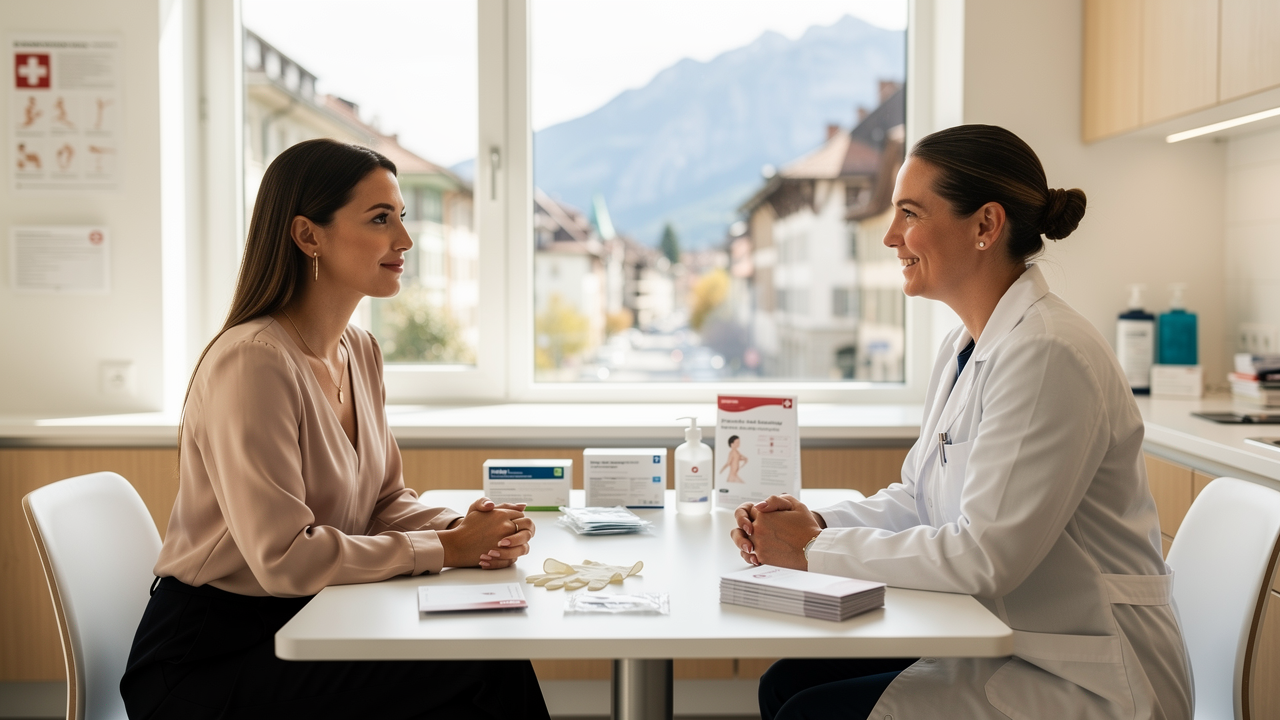
A practical guide to sexual health, testing, vaccinations, and hygiene for sex workers in Switzerland. Where to test for free, how often, and what the system offers
Updated May 2026
Contents
- Why this guide exists
- STI testing. Frequency and types
- Where to get tested in Switzerland
- Vaccinations to consider
- PrEP and PEP. Prevention tools
- Contraception
- Workspace hygiene
- Mental health and burnout
- Frequently asked questions
- Support and resources
01Why This Guide Exists
Sexual health for sex workers in Switzerland is well supported by infrastructure but rarely explained in plain terms. There are dedicated sexual health centers, free or reduced-rate testing, accessible vaccinations, and a strong tradition of confidential service. Most workers who use these services pay nothing or very little. Yet many never access them because they are not told they exist, or because the information sits behind generic public health messaging that does not address their specific reality.
This guide is the practical version. What to test for, how often, where to go, what is covered, what is not. Aspasie, FIZ, and the Aide Suisse contre le Sida (ASCS) provide the foundation; this guide compiles their key points in one place.
For the broader safety context, see our safety guide for independent escorts.
02STI Testing. Frequency and Types
The Swiss Federal Commission for Sexual Health (CFSS) and the Aide Suisse contre le Sida recommend regular testing for people with multiple sexual partners. For sex workers, the practical baseline is a complete STI panel every 3 months, with adjustments based on exposure events.
What a complete panel covers
Standard STI testing panel for sex workers
| Infection | Test type | Recommended frequency |
|---|---|---|
| HIV | Blood test (window: reliable from 6 weeks after exposure) | Every 3 months |
| Syphilis | Blood test | Every 3 months |
| Chlamydia | Urine sample or vaginal swab | Every 3 months |
| Gonorrhea | Urine sample, vaginal/throat/rectal swab depending on practices | Every 3 months |
| Hepatitis B | Blood test (only if not vaccinated) | Once, then post-vaccination check |
| Hepatitis C | Blood test | Once a year, more if exposure to non-sterile material |
When to test outside the routine cycle
- After a condom breakage or unprotected exposure
- After contact with a partner who has been diagnosed with an STI
- If symptoms appear (genital discharge, sores, burning, pelvic pain)
- Before changing primary form of contraception or starting PrEP
Window periods
- HIV: reliable from 6 weeks after exposure (CFSS recommendation since 2018)
- Syphilis: detectable from 3 to 6 weeks
- Chlamydia and gonorrhea: detectable from about 1 to 2 weeks
- Hepatitis B: window of 6 to 8 weeks for reliable detection
03Where to Get Tested in Switzerland
Sex workers in Switzerland have access to specialized centers offering free or reduced-rate testing, often with explicit experience working with the profession.
Geneva
- Aspasie partners with a laboratory offering reduced rates exclusively for sex workers, accessible with a “Bon Aspasie” voucher available at their drop-in. Tests cover HIV, hepatitis B, syphilis, gonorrhea, chlamydia (urine sample possible).
- Groupe Sida Genève offers free anonymous HIV testing on demand at their location.
- Checkpoint Geneva (Rue de Lausanne 54) offers HIV and STI testing, treatment, and mental health support.
- Unité de santé sexuelle et planning familial at HUG offers full sexual health services on a sliding scale.
Zurich
- FIZ in collaboration with health partners offers testing access for migrant sex workers
- Checkpoint Zürich (Konradstrasse 1) offers HIV/STI testing, PrEP, PEP, and consultations
- Zurich Aids-Hilfe coordinates regional sex worker-friendly testing
Other cantons
- Lausanne: Fleurs de Pavé, Profa, Unisanté
- Bern: Xenia coordinates with Bernese sexual health centers
- Basel, Lucerne, St. Gallen: regional Aids-Hilfe centers
- National directory: aids.ch lists confidential, low-cost testing centers across all cantons
Testing through your standard caisse-maladie (LAMal) is not anonymous. The test result is associated with your name in the insurer’s records. For confidentiality, use a sexual health center directly, paying out of pocket or with the reduced-rate vouchers Aspasie and similar organizations provide.
04Vaccinations to Consider
Vaccination is the most reliable form of protection against several infections that condoms cannot fully prevent.
Recommended for sex workers
- Hepatitis A and Hepatitis B. Combined vaccine (Twinrix) available. Three doses over 6 months. Highly recommended.
- HPV (human papillomavirus). The Federal Office of Public Health recommends HPV vaccination for adolescents and young adults up to 26 years. Sexual health centers extend the recommendation to sex workers of any age. Reduces risk of cervical cancer, anal cancer, and genital warts.
- Mpox (monkeypox). Recommended for higher-risk populations including some sex workers. Available through public health channels.
- Standard adult vaccines. Tetanus, diphtheria, pertussis, MMR, varicella as per general adult schedule.
Where to get vaccinated
General practitioners, sexual health centers, and pharmacies (for some vaccines, in cantons that allow direct pharmacy administration). Costs are typically partially covered by LAMal for recommended vaccines, fully out of pocket if you prefer to keep it off your insurance record.
05PrEP and PEP. Prevention Tools
Two HIV-specific prevention tools are widely available in Switzerland.
PrEP (Pre-Exposure Prophylaxis)
PrEP is a daily medication that prevents HIV infection. For sex workers and other high-exposure populations, PrEP is now part of the standard prevention toolkit in Switzerland.
- Prescribed by a doctor at a sexual health center or by a GP familiar with the protocol
- Standard regimen: one daily pill (Truvada or generic equivalents)
- Requires HIV testing every 3 months and renal function checks
- Cost: around CHF 30 to 50 per month for generic Truvada in Switzerland; LAMal coverage varies
- Reduces HIV infection risk by over 95% when taken consistently
PEP (Post-Exposure Prophylaxis)
PEP is emergency treatment after a potential HIV exposure (condom breakage, unprotected sex with a partner of unknown status, etc.).
- Must be started within 72 hours of exposure (sooner is better, ideally within 24 hours)
- Available at hospital emergency departments and at specialized centers
- Treatment lasts 28 days
- Cost is covered by LAMal in case of recognized exposure
06Contraception
Pregnancy prevention is part of sexual health beyond STI prevention. The standard options apply equally to sex workers, with some configurations particularly suited to the profession.
- Hormonal IUD or copper IUD. Long-acting (3 to 10 years), discreet, no daily action required. Often the recommendation of choice for sex workers due to reliability and lack of management overhead.
- Contraceptive implant. 3 years of protection from a small subdermal device.
- Pill, patch, ring. Effective if used consistently; daily attention required for the pill.
- Emergency contraception. Available without prescription in pharmacies (Norlevo, EllaOne). Most effective in the first 24 to 72 hours.
The choice depends on personal medical history and preferences. Consultation with a gynecologist or a sexual health center clarifies the right option for you.
07Workspace Hygiene
Hygiene at the workspace is straightforward but easily neglected when work gets busy.
Between sessions
- Clean linens (sheets, towels, pillow covers) between every client
- Wash with detergent at 60°C minimum
- Disposable bed protection (paper sheets, single-use sheets) is a common practical solution for high-volume days
- Surface cleaning of touched areas (handles, switches, bathroom)
- Air the room between sessions when possible
Personal hygiene
- Shower with each client (yours and theirs, before and after when appropriate)
- Wash hands frequently
- Mouth rinse if practicing oral, between clients
Equipment
- Condoms: variety on hand (sizes, allergies), well stocked, stored away from heat
- Lubricants: water-based (compatible with condoms), silicone-based for specific use; check expiration dates
- Toys: thoroughly cleaned between clients with appropriate methods (boiling, sterilizing wipes, dishwasher for compatible toys), or single-use if shared use is not possible to clean reliably
- Gloves: disposable, especially for fingering, anal play, or any contact with mucous membranes
Supplies inventory
A monthly inventory check prevents running out at inconvenient times. Standard supplies for a busy independent worker include:
- 200 to 400 condoms per month (varies by activity volume)
- Lubricant (multiple types)
- Tissues, hygiene wipes
- Disposable bed protection if used
- Cleaning products for the workspace
- Mouthwash, breath mints
08Mental Health and Burnout
Sexual health is not only physical. Mental health is part of the same conversation.
What the work asks of you mentally
- Sustained emotional regulation across many interactions
- Boundary maintenance with clients who may push them
- Identity separation between professional self and personal self
- Managing the stigma still associated with the profession in some social circles
- The intensity of independent work without colleagues to share the load
Signs that warrant attention
- Persistent fatigue not relieved by rest
- Loss of interest in clients, services, or the work itself
- Difficulty separating from work in personal life
- Sleep disturbances
- Increased reliance on alcohol, substances, or stimulants
- Isolation from non-work social connections
Resources for mental health
- Aspasie’s psychological consultation in Geneva
- FIZ’s counseling service in Zurich
- Checkpoint centers (Geneva, Zurich, Lausanne) include mental health professionals
- La Main Tendue (143) for emotional crisis support, 24/7, multiple languages
- Standard psychotherapy with a chosen therapist (covered by LAMal under specific conditions; consult your insurer)
Burnout in sex work is real and underreported. Establishing a sustainable rhythm with real off days, time outside work-related activities, and regular contact with non-work relationships is part of long-term wellbeing. A few weeks of reduced bookings is sometimes the most productive thing you can do for the next year.
09Frequently Asked Questions
Is testing actually free for sex workers in Switzerland?
For specific tests at specific centers, yes. Aspasie’s partner laboratory in Geneva offers reduced rates exclusively for sex workers; some tests are free. Checkpoint centers and regional Aids-Hilfe offer free or low-cost anonymous testing. Going through your standard caisse-maladie incurs the deductible and is recorded in your insurance file.
Are STI test results confidential when going through a sexual health center?
Yes. Specialized centers (Checkpoint, Aspasie partner labs, Groupe Sida Genève) operate under strict confidentiality, and many offer fully anonymous testing. Results are not shared with insurance, with employers, or with cantonal authorities.
Should I get tested before starting sex work or is it for ongoing only?
Both. Initial testing establishes a baseline. Ongoing testing every 3 months is the standard for active sex workers. Aspasie and similar organizations offer a baseline test as part of their welcome package for new sex workers in their canton.
Is HPV vaccination still useful if I am over 26?
Sexual health centers commonly extend the recommendation beyond 26, particularly for sex workers, even if standard public health guidelines target younger populations. The benefit is reduced for older patients but not zero. Discuss with a sexual health professional.
Can I get PrEP if I am not Swiss-domiciled?
PrEP can be prescribed by a Swiss doctor regardless of residency. The cost may be higher without LAMal coverage, but generics make it affordable in most cases. Some sexual health centers run specific PrEP access programs for migrant populations.
What about testing for clients who claim recent results?
Take it as additional information, not as a substitute for your own protection. Even a real recent test by a client does not cover transmissions during the window period after their last exposure. Condom use remains the standard.
How do I handle a positive test result?
Most STIs are curable with treatment (chlamydia, gonorrhea, syphilis, hepatitis B in many cases). HIV is a chronic condition managed with daily medication, with a near-normal life expectancy when treated early. Sexual health centers handle the diagnosis, treatment, and partner notification confidentially. None of this is a barrier to continuing work, with appropriate medical management and reasonable adjustments.
What if I do not have LAMal coverage?
Sexual health centers and specialized organizations have programs for people without insurance coverage, including migrants, sex workers in transitional situations, and short-term visitors. Aspasie, FIZ, and Checkpoint centers can advise on options.
10Support and Resources
Sexual health support in Switzerland is one of the strongest networks in Europe. The infrastructure exists. Using it is the practical question. Most workers who set up a regular testing rhythm with a specialized center find the system supportive, confidential, and well organized.
Aide Suisse contre le Sida
National federation. Testing center directory, multilingual support.
Aspasie
Geneva. Reduced-rate testing voucher, partner laboratory, full health support.
Checkpoint Geneva
HIV/STI testing, PrEP, PEP, mental health
Checkpoint Zurich
HIV/STI testing, PrEP, PEP, mental health
FIZ
Zurich. Health support for migrant sex workers.
Santé Sexuelle Suisse
National sexual health platform with center directory
Disclaimer: This guide is for informational purposes only and does not constitute medical advice. Always consult a qualified medical professional for testing, vaccination, contraception, and treatment decisions. Sexual health recommendations evolve; verify with a sexual health center for the most current protocols.
Last updated: May 2026